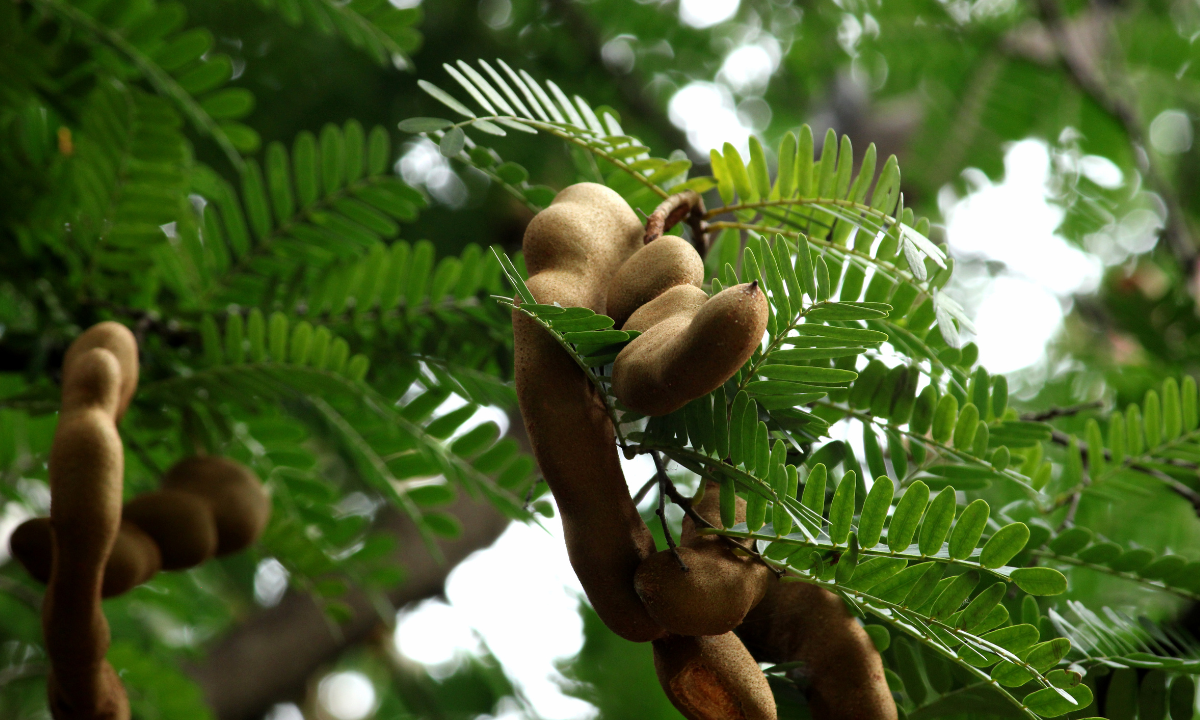
By the well outside the gate… there stands a tamarind tree! That's how the song should go in South India, because you encounter tamarind trees in the South Indian shade just as frequently as you find linden or chestnut trees here. When we visited our friend and Ayurveda physician Dr. Lal in Calicut years ago, a magnificent 20-meter-tall tree with cheerful-looking evergreen leaves towered in front of his small practice house. Every morning, rounded brown pods lay on the ground waiting to be collected and processed.
Learn what you can make with tamarind and what effects Ayurveda attributes to the brownish-red paste from tamarind pods in this blog article.
The Most Important Facts at a Glance
- The tamarind tree is an evergreen legume tree that grows very slowly.
- Tamarind contains valuable minerals such as iron, calcium, and magnesium.
- The fruit has antiseptic and mildly laxative properties.
A Little Botany About the Tamarind Tree
The tamarind tree, botanically Tamarindus indica, is an evergreen legume tree that grows very slowly and has extremely hard wood. Tamarind is also known as the "Indian date" or "sour date." It takes the tamarind tree up to ten years before the first fruits appear. The tropical tree has deep roots and grows between five and 25 meters tall. At night, it folds its small elliptical leaflets together and goes to sleep, so to speak. Its exact origin is unclear, though the tamarind tree is suspected to originate from North Africa. From there, it likely traveled to Asia fairly early and today is even distributed in the Mediterranean region and South America.
Between December and March, the red flowers of the tree produce elongated and brownish fruit pods that—depending on the variety—become five to 20 cm long. When ripe, the tamarind fruit pods are light brown to grayish and contain two to ten hard seeds, as well as the delicious tamarind pulp. Depending on the variety, the color and taste of the tamarind pulp in the pods vary. While wild forms can be very sour, cultivated tamarind trees have the familiar and popular sweet-sour aroma.
Important: You should not confuse Tamarindus indica with the fruit of Garcinia Cambogia, the so-called "Malabar tamarind." The fruit of the Malabar tamarind resembles a small pumpkin. Due to its high content of hydroxycitric acid, Malabar tamarind is said to have an appetite-suppressing effect. However, this has not yet been scientifically proven!
How Healthy Tamarind Is: Valuable Ingredients
The Indian date is packed with important minerals, making it an interesting addition to daily nutrition not only for vegans and vegetarians. In addition to the water, fiber, and carbohydrates naturally found in fruits, it contains a respectable amount of iron, calcium, phosphorus, magnesium, and vitamin D. There are also tartaric acid and cinnamic acid. When consumed in larger quantities, tamarind has a mild laxative effect, so you shouldn't use it too generously in your smoothie every day.
Tamarind in the Kitchen
Almost everywhere this tree grows, its fruits and flowers are processed. You can make salads from the flowers and refreshing lemonade from the tamarind pulp. The pulp of tamarind is mainly used in the kitchen. Whether Indian, Thai, Indonesian, or Chinese, Asian cuisine loves the herb-sweet tamarind in the form of chutneys, confections, and sweet-sour curries. Of course, there are countless African, South American, and Persian dishes with tamarind, such as tamarind vinegar, candied tamarind with chili, or braised meat with pomegranate seeds and tamarind paste.
European cuisine, by the way, is not entirely without tamarind either: As an ingredient in British Worcestershire sauce, tamarind has been part of European cuisine since the 19th century!
Tamarind and Its Effects in Ayurveda
Tamarind has not only antiseptic but also mildly laxative properties. Ayurveda explains this through the sour Rasa (taste). The so-called thermal property (Virya) is heating, and the taste after digestion (Vipaka) is also sour. The effect of tamarind on the Doshas is Vata-reducing, while Pitta and Kapha are stimulated.
Ayurveda frequently uses tamarind in treating addiction disorders. For instance, a formula against addictions, especially alcohol, recommends a decoction or syrup made from: dates, black raisins, pomegranate, Indian gooseberry (Amla), and tamarind.
Scientific findings on tamarind's mode of action come mainly from Asia. Here, for example, antibacterial effects and applications in treating fever, type 2 diabetes, and eczema have been researched. The effects of tamarind and its fruits have already been documented in several tests and studies.
Conclusion
The tamarind tree is a versatile tree whose fruits are valued not only in the kitchen but also in Ayurveda. With its valuable ingredients and special effects on the Doshas, it is an interesting component of nutrition and healthcare.