Finally March: The days grow brighter and the sun gently awakens us from our winter sleep. Yet just now, when nature finally calls us to "wake up" with lots of birdsong, the human organism often responds with lack of drive, fatigue, and irritability. Spring fatigue settles over springtime vigor. You feel like you can't fully wake up all day, feel energyless or not at your best physically. What's actually behind spring fatigue and how can Chyawanprash and Ayurvedic medicine help?
The essentials at a glance
- Spring fatigue is caused by seasonal climate change and hormonal changes.
- Rasayanas like Chyawanprash are known Ayurvedic remedies for strengthening and rejuvenation.
- Chyawanprash contains over 80 different roots, herbs, and fruits, including the amla fruit.
- Chyawanprash balances all doshas and supports substantial renewal processes.
Rasayanas against spring fatigue
Spring fatigue is caused by the hormonal changes brought about by seasonal climate shifts. We essentially switch from winter metabolism to summer metabolism – after all, our body, driven by increasing sunlight, wants to produce more serotonin and simultaneously break down and lower the sleep hormone melatonin produced over winter. This costs the organism increased energy and gives us the feeling of being run down. Often the symptoms of spring fatigue are attributed to a vitamin or iron deficiency, which can result from the often less varied diet in winter. While medical research still owes us a scientifically examined answer to the question of the origin of spring fatigue, we find in the thousands-of-years-old Ayurvedic medicine numerous proven herbal blends that are used for symptoms like headaches, lack of drive, difficulty concentrating, and diffuse physical weakness: the Rasayanas.
Chyawanprash and other Rasayanas in Ayurveda
To strengthen, rejuvenate, and support the metabolism of an exhausted and fatigued organism when waking up, Rasayanas are used in Ayurvedic medicine. Rasayanas are popular energy boosters used for all kinds of deficiencies to nourish and build up a weakened organism. The most famous Rasayana in Ayurvedic medicine is probably Chyawanprash. The herbal-fruit paste is considered one of the most effective strengthening and rejuvenating remedies; it protects against wasting and exhaustion, provides stability, and serves as general support for recovery processes of all kinds. It is therefore frequently used after prolonged illness, with diffuse weakness, or to build up after reduced food intake. Another Rasayana is Badam, the spiced almond milk.
Chyawanprash - the Ayurvedic remedy for physical and mental refreshment
Chyawanprash got its name from Chyavana. The Rigveda, one of the Vedic scriptures, tells of Chyavana, a very old man who was transformed by the divine physicians, the Asvin, into an agile young man.
As is often the case with transliterating Sanskrit into Latin characters, numerous variations of the same word circulate: sometimes endings are added or omitted, unfamiliar sounds are idiosyncratically transposed, or letters are switched. The most common variants for the amla paste are: Chyavanaprasha, Chyavanprash, or simply: Chyawanprash.
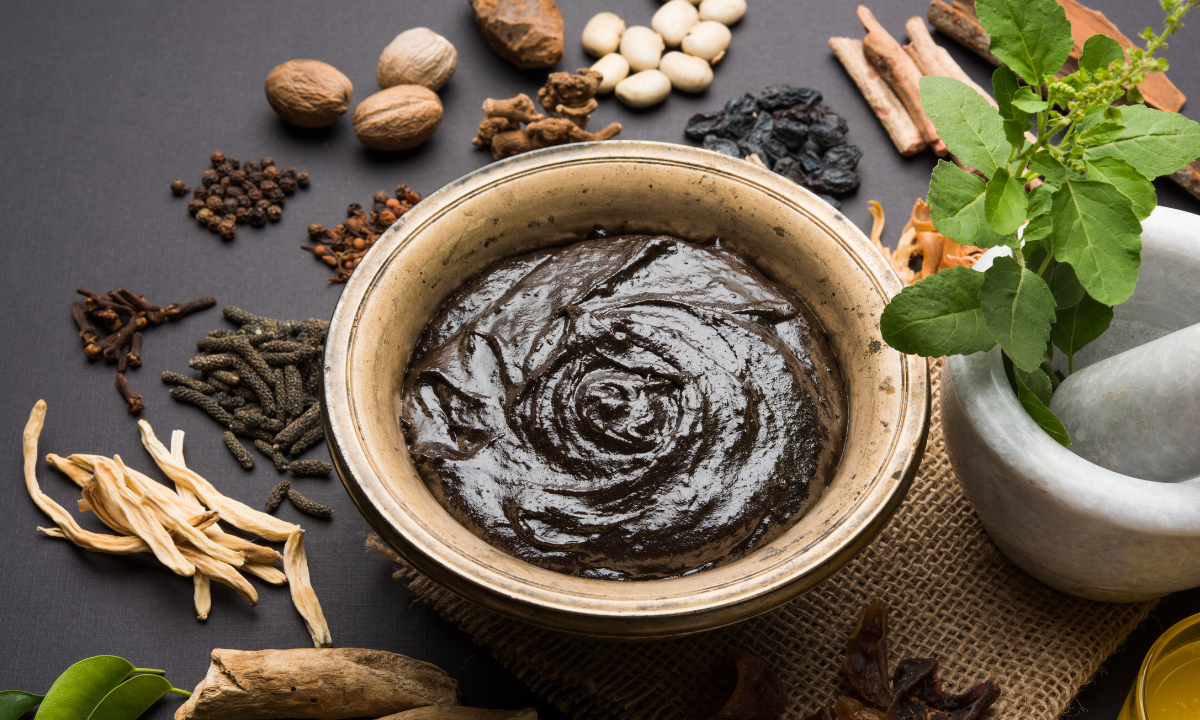
Chyawanprash or Cyavanaprasa avaleha (licking medicine, paste) is also known as amla paste and looks optically like a thick, spiced plum jam. However, the Ayurvedic energy concentrate tastes, smells, and works quite differently, as according to the original recipe over 80 different roots, herbs, and fruits come together in it! Most important is the amla fruit (phyllantus emblica, synonymous with the Indian gooseberry, emblica officinalis). Amla is not only a vitamin wonder; the small green fruit is said to have immune-strengthening, metabolism-stimulating, and even life-energy-increasing effects.
2000 years later: Chyawanprash no longer entirely original
The original recipe for Chyawanprash is now about 2000 years old. Some of the 80 ingredients that according to the original text belong in the amla paste no longer exist. Several of the plants used are now extinct or on the red list of particularly endangered species. Mostly these are rare orchid varieties. Today's formulas are strongly oriented toward the original but now contain only about 50 ingredients, though not all manufacturers disclose their formula. For example, Maharishi Ayurveda's Chyawanprash simply says "cane sugar, amla fruit, ghee (clarified butter), honey, bamboo arundo (Vanshlochan), long pepper (Piper longum), saffron, cinnamon, herbal and spice blend."
Chyawanprash: Application
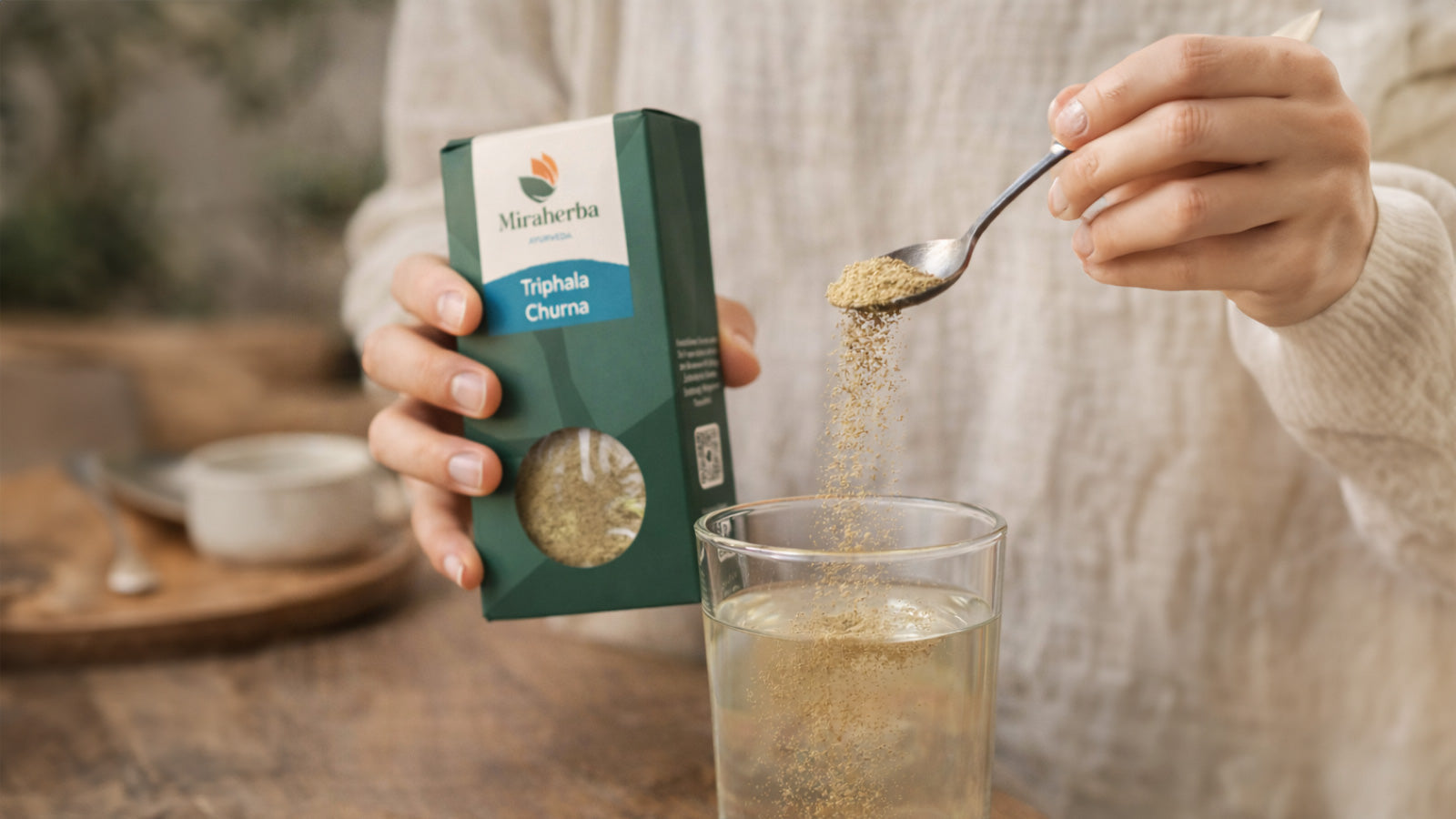
Classically, you consume the strengthening dietary supplement in the morning in the form of 1-2 teaspoons of pure paste (hence the word aleva, the licking paste). We also like Chyawanprash on a slice of bread and recommend to all our patients who find the taste too intense to simply dissolve 1-2 teaspoons of amla paste in a cup of warm water or milk and drink it.
Chyawanprash: The effect – what Ayurveda has to say
From an Ayurvedic perspective, Chyawanprash is a remedy that balances all doshas and supports the organism in substantial renewal processes. In the Materia Medica, the effect of Chyawanprash is described as follows:
"The Rasayana is suitable for emaciated, injured, and elderly people and promotes development in children. It is helpful for kasa – bronchitis, svasa – shortness of breath, trsna – stress, hrdroga – heart-strengthening, vatarakta – for peripheral vascular diseases, arthritis, gout, urinary and seminal disorders. With daily use, even an elderly person attains intelligence, good memory, radiance, freedom from disease, longevity, strength of the senses, and sexual power. He sheds the form of old age and dons the garment of youth." Ayurveda Materia Medica
The classical formula and exact description of the elaborate manufacturing process of Chyawanprash can be found in the Charaka Samhita, the medical Vedic texts. Following this classical composition, there are now many manufacturers who also produce this energy-giving paste in organic quality. Partly, however, with slightly modified formulas, as not all herbs and spices are freely available. Some of the valuable ingredients are now even subject to species protection.
What does Chyawanprash contain besides amla paste?
As we already know, the most important component of Chyawanprash is amla or Amalaki, a gooseberry-like fruit that grows on tall trees and is offered in every market in India. The fruit itself is hard and not particularly suitable for pure consumption taste-wise. Amla contains all tastes except salty. This is considered particularly valuable in Ayurvedic medicine and dosha-balancing. Its high vitamin C content is highly bioavailable due to the other accompanying substances of the fruit.
The base of Chyawanprash consists of amla, cane sugar, honey, and ghee. Important spices and herbs are long pepper, cinnamon, cardamom, Indian bay leaf, Ashwagandha, and bamboo. The spices have an Agni-stimulating effect. This is no accident, as the digestive fire is considered the source of physical health in Ayurveda. When it burns evenly, food can be optimally broken down and the body receives all important vitamins, minerals, and trace elements.
That Chyawanprash consists of almost half palm sugar (jaggery) is not a shortcoming from an Ayurvedic perspective. Jaggery is also considered a Rasayana and has positive effects on physical and mental renewal and stability. And since Chyawanprash has all six tastes through the versatile amla and has a sweet post-digestive effect (madhuravipaka), it works simultaneously as both nourishing-regenerative and detoxifying-vitalizing.
Conclusion
Chyawanprash is suitable for all age groups. Used daily, it helps with diffuse weakness. If this persists despite healthy nutrition, regular intake, and plenty of exercise in fresh air for more than four weeks, please consult your doctor or naturopath – unfortunately, not everything can be attributed to spring fatigue.